Sleep as Infrastructure: Why Engineers Should Treat Rest Like an SLA
Sleep deprivation silently degrades your cognitive SLOs. Learn how to treat rest with the same rigour you apply to production systems.
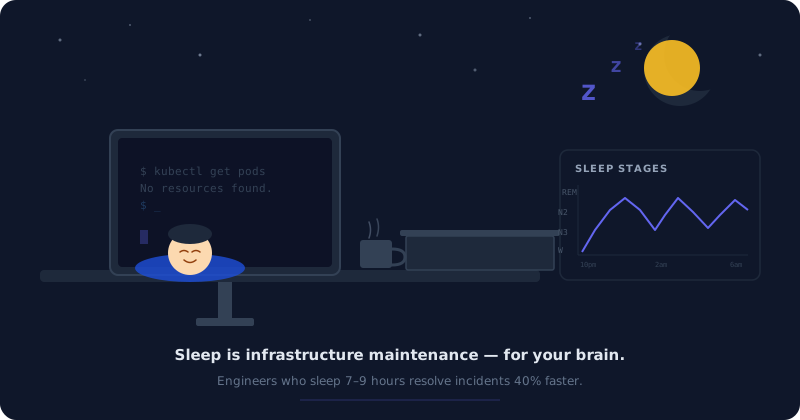
The System You Never Monitor
You instrument everything. Latency, error rates, saturation, traffic. You have dashboards, alerts, and runbooks for every critical service — except the one that operates all the others.
Your brain runs 24/7. It handles incident triage, architectural decisions, code review, and the social dynamics of distributed teams. And like any system under sustained load without maintenance windows, it degrades. The difference is that CPU throttling shows up in Grafana. Cognitive degradation shows up in the incident timeline, six weeks later, when someone asks why nobody caught that edge case in the code review.
Sleep is the maintenance window. And most engineers are running it on a best-effort, no-SLA basis.
What the Research Actually Shows
The cognitive effects of sleep restriction are well-documented and consistently underestimated by the people experiencing them:
Reaction time and error rates increase sharply after fewer than six hours of sleep — comparable, in some studies, to operating with a blood alcohol level of 0.05%. You feel fine. You are not fine.
Working memory — the capacity to hold multiple states in mind simultaneously — degrades measurably after even one night under seven hours. This is precisely the faculty you need for debugging distributed systems, where you’re tracking service state, request flow, and possible failure modes in parallel.
Decision quality under uncertainty drops. Engineers who are sleep-deprived default to familiar patterns rather than reasoning freshly through novel problems. That’s a reasonable heuristic when you’re healthy. When a novel failure mode requires fresh thinking, it becomes a liability.
Emotional regulation — the capacity to stay calm in a high-stakes incident bridge, give useful feedback in a charged code review, or push back diplomatically on an unrealistic deadline — is among the first capabilities sleep deprivation impairs.
Cognitive SLO: Target > 90% decision accuracy
Current sleep: 5.5 hrs/night average
Estimated SLO compliance: ~68% (degraded)
The number most engineers don’t track: what is your mean sleep duration over the past 30 days?
Common Patterns That Erode Sleep Quality
Late on-call noise
Alerts that fire between 11 PM and 6 AM are the leading structural cause of sleep disruption for engineers. Even when they auto-resolve, the act of waking, checking a phone, and re-entering sleep costs 20–45 minutes of recovery time. Two of those per week for a year is roughly 40 hours of lost sleep — equivalent to a full work week — taken entirely out of your recovery time.
The fix is not personal: it’s reducing alert noise at the team level. See the related article on on-call burnout for structural approaches.
Blue light and pre-sleep stimulation
Reviewing production dashboards at 10 PM keeps you in an operational mindset that is neurologically incompatible with sleep onset. The problem isn’t just blue light (though melatonin suppression is real) — it’s the arousal state that incident-pattern-recognition creates in your nervous system.
A practical rule: no production systems in the 60 minutes before your intended sleep time. Slack can wait. The cluster is monitored by the on-call, not by you, tonight.
Caffeine timing
Caffeine has a half-life of roughly 5–7 hours. A coffee at 3 PM means a quarter of that dose is still in your system at 11 PM. For engineers running on afternoon espresso to push through afternoon meetings, this is a common and invisible cause of poor sleep quality — not inability to fall asleep, but reduced deep sleep, which is where cognitive restoration actually happens.
Irregular sleep timing
Your circadian rhythm is a clock that thrives on consistency. A sleep schedule that varies by more than 90 minutes across the week — common for engineers who stay up late on weekends — produces what sleep researchers call “social jet lag.” The physiological effects are similar to crossing two time zones every Friday and returning Sunday night.
Treating Sleep Like Infrastructure
If you maintain services professionally, you already have the mental model for this. Apply it:
Define your SLO. For most adults, 7–9 hours is the target range. Fewer than 6 hours is an SLO breach. What’s your 30-day average?
Instrument it. A basic wearable or even a consistent sleep journal gives you data. You can’t improve what you don’t measure. The metric that matters most isn’t total time — it’s consistency of sleep and wake times.
Set a maintenance window. Pick a wind-down window — 45 to 60 minutes before sleep — and protect it the same way you’d protect a maintenance window in production. No deploys, no incidents you’re not actively on-call for, no Slack threads that can wait.
Audit your alert noise. If you’re being woken by pages that didn’t require action, that is a quality-of-service problem that belongs in your next retrospective. Log every nocturnal page for a month. Bring the data to your engineering manager.
Build recovery into the rotation. After a shift with significant overnight disruption, recovery sleep is not optional — it’s operational. Teams that don’t build in recovery time after disruptive on-call shifts are drawing down their engineers’ cognitive reserves with no plan to replenish them.
The Sustainability Case
Engineers who average fewer than six hours of sleep are not working harder — they are working at reduced capacity, incurring cognitive debt that compounds the same way technical debt does, and increasing their risk of burnout, error, and eventually attrition.
The most productive thing many engineers could do for their output, their team, and their own longevity in this industry is to treat sleep as a non-negotiable operating requirement — not a lifestyle choice for people with fewer commitments.
You wouldn’t run a database without backups and call it “working harder.” Don’t do it to your brain.
Further Reading
- Why We Sleep — Matthew Walker (foundational; the research summary is dense but accessible)
- Huberman Lab: Master Your Sleep — practical, mechanism-level protocols
- Sleep Foundation: How Much Sleep Do Adults Need? — evidence-based reference ranges